These notes are mostly inspired by the Practical AI for investigative journalism sessions.
There are many excellent uses for AI in journalism. You can find a lot of them on Journalist’s Toolbox.
There is one important thing to keep in mind: AI tools are machines that generate text, not facts.
Let’s look at an example. I asked Claude to tell me Who is Nicu Calcea?.
Nicu Calcea is a Romanian politician who has served as a member of the European Parliament since 2019. He is a member of the National Liberal Party (PNL) which is a center-right liberal-conservative political party in Romania.
Some key facts about Nicu Calcea: born in 1968 in Buzau, Romania; background in economics; elected to the European Parliament in 2019; sits with Renew Europe; focused on economic and monetary affairs and the single market.
Claude sounds very confident and provides a detailed answer. However, every single one of those facts is false. I know, because I am Nicu Calcea and there is no Romanian politician with the same name.
In the context of large language models, these falsehoods are called hallucinations.
How AI works
Let’s assume I ask you to guess the next word in this sentence: I'm .... The answer could be hungry, confused, Nicu, or something else entirely.
What about I haven't eaten since yesterday, I'm ...? Then a better answer is probably hungry or starving.
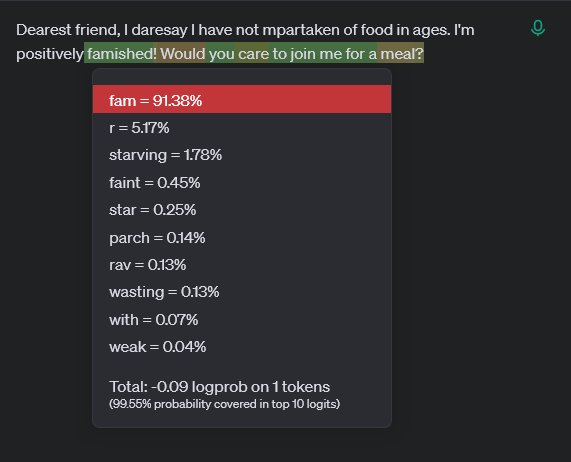
Now take: Dearest friend, I daresay I have not partaken of food in ages. I'm positively... Based on the style, famished is a much better fit.
What we just did was look at the words that came before and choose the most likely continuation. That is broadly how an LLM works.
You can see this in action in the OpenAI Playground. Copy that last sentence into the text box, tick Show probabilities, and submit it.
You’ll notice the completed words are highlighted in different colours. Clicking on them shows alternative tokens and their probabilities. In one run, the sentence ending I'm positively had a 91.38% chance of being followed by fam, which then had a 99.87% chance of being followed by ished, and so on.
To keep responses dynamic, LLMs apply randomness when choosing the next token. That means the same question can give different answers.
You can control that randomness with the Temperature setting. Lower values make the reply more predictable; higher values make it more creative. In journalism, you usually want 0.
In essence, an LLM is a very advanced next-word predictor. That’s why you cannot assume its output is true even when it sounds plausible.